|
Rajasthani
Jewellery
Big,
colourful traditional necklaces, armlets, anklets, earrings
and rings are the part of Rajasthani culture. Both men and
women wear all kinds of jewellery. With the advent of the
Mughal Empire, Rajasthan became a major centre for production
of the finest and intricate kind of jewellery. It was a true
blend of the Mughal with the Rajasthani craftsmanship. The
Mughals brought sophisticated design and technical know-how
of the Persians with them. The common link was the inherently
decorative nature of the Muslim and Hindu Art. Dazzling beauty
of Rajasthani art attracts tourists from the world over.
The jewellers of Rajasthan specialised in the setting of precious
stories into gold and the enamelling of gold. Jaipur, and
to some extent Alwar, emerged as the enamelling centres in
the eighteenth and nineteenth century. Enamelling was introduced
by Maharaja Man Singh who had cordial relations with Akbar.
For enamelling, the piece to be worked on is fixed on a stick
of lac and delicate designs of flowers, birds and fishes are
carved on it. A wall is made to hold the colours, while engravings
are made in the grooves to heighten the interplay of the transparent
shades, thus enhancing the beauty of the jewel. The surface
is fully burnished by agate; then the enamel colours are filled
in painstakingly as in a miniature painting. The article is
then left in the oven on a mica plate to keep it off the fire.
Colours are applied in order of their hardness; those requiring
more heat first, those requiring less, later. When set, it
is rubbed gently with the file and cleaned with lemon or tamarind.
The craftsmen in Jaipur are believed to have originally come
from Lahore. In Jaipur the traditional Mughal colours of red,
green and white are most commonly used in enamelling.
A quintessentially Indian technique and a specialty of Rajasthan
is the setting of stones by means of Kundan, the jewellery
in which stones are set, is rarely solid gold, it has a core
of lac, a natural resin. The pieces which make up the finished
object are first shaped by specialised craftsmen (and soldered
together if the shape is complicated) and left in separate
hollow halves. When the stones are to be set, lac is inserted
in the back, and is then visible in the front through the
holes. Highly refined gold, the Kundan, is then used to cover
the lac and the stone is pushed into the kundan.
More kundan is applied around the edges to strengthen the
setting and give it a neat appearance. This was the only form
of setting for stones in gold until claw settings were introduced
under the influence of western jewellery in the nineteenth
century.
More than one craftsman was often involved in the making of
a single piece of jewellery. The Chiterias made the design,
the Ghaarias the engraving, the Meenakari as the enameller
and the Sunar was the goldsmith. These craftsmen received
patronage from the nobles and the kings.
Many of the old styles remain unchanged till today. In Pratapgarh
a special type of quasi-enamelling is done in which extremely
fine work on gold is daintily carried out on green enamel
which forms the base. In Nathdwara a good deal of enamel work,
on silver and other metals is done continuing the tradition
of this famous age old craft.
The Masculine Jewellery
Vanity,
a love of richness and deep aesthetic sense gave the Rajas
and Ranas of Rajasthan a great fondness for jewellery. The
men were as elaborately and dazzlingly dressed as the women,
with jewellery that often rivalled that of their wives. It
was a status symbol and a portable display of wealth, and
consequently, power.
Turban jewellery was the prerogative of the king, his close
family or the members of his entourage (including his horse).
The turban it-self would be heavily encrusted with jewels
and fastened with a gem set kalangi or aigrette. Men also
wore necklaces of pearls and precious stones, carring jewelled
sashes around their waists and several rings on every finger.
The ornament worn in front on the turban is called a sarpech.
It was often extended into a golden band set with emeralds,
rubies, diamonds. Pearls were greatly valued by the Maharajas
and they often wore double or triple strings of pearls with
pendants of precious stones round their necks. The sashes
round their waists were heavily jwelled as were the clasps
or buckles of their sword belts.
Masculine jewellery was not confined to articles worn on the
body alone. The Rajasthani princes had gold epulets, gem encrusted
sword hilts, dagger sheaths, sword scabbards and hookah mouthpieces.
The Feminine Jewellery
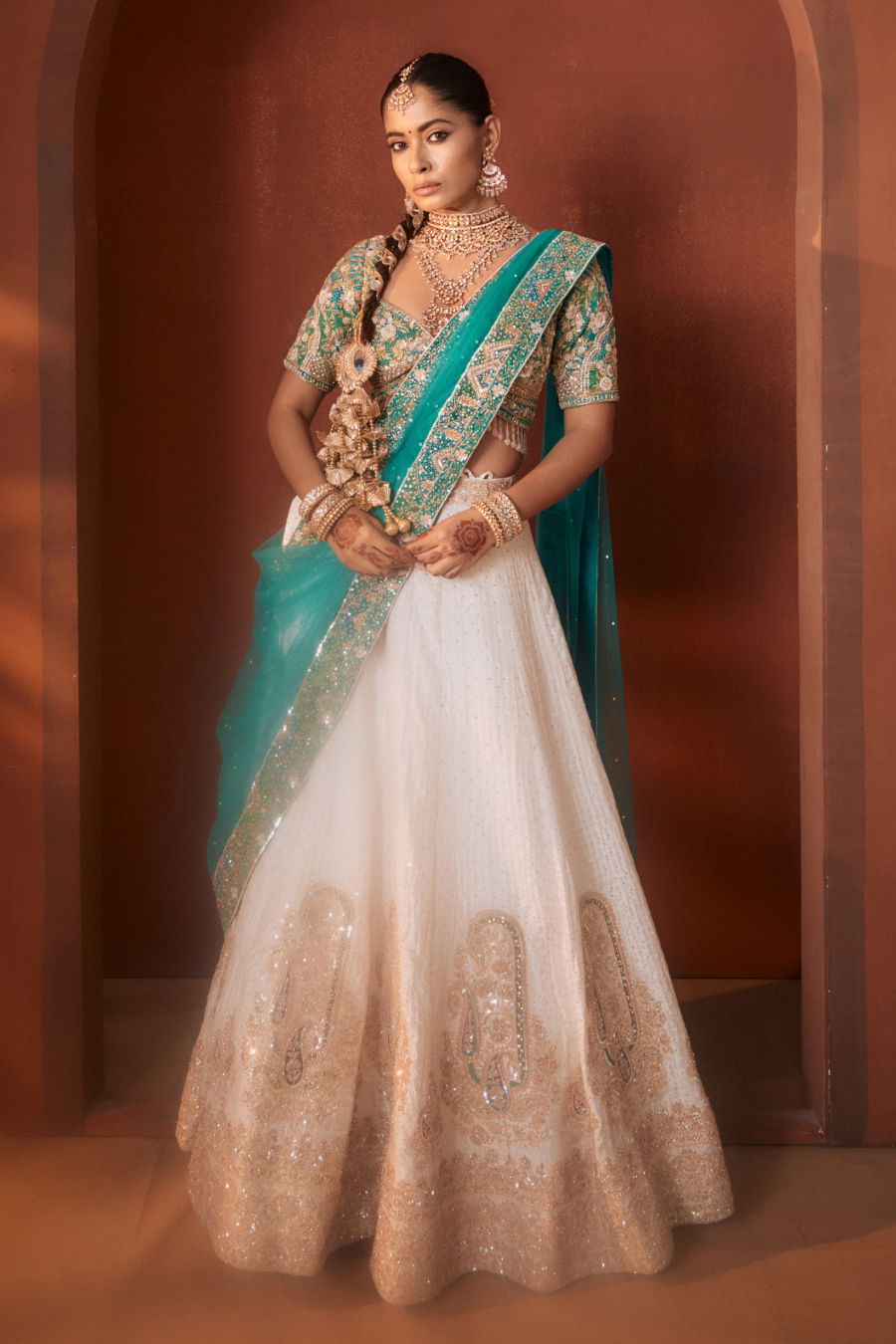
Feminine jewellery is more complex but a beautiful form of
art than the masculine jewellery. Jewellery in India is worn
as a complete ensemble, and not as an accessory. It is thus
quite acceptable to wear more than one necklace around the
neck, also in the ears, on the arms and the ankles, rings
on the toes and fingers, ornaments on the forehead, in the
hair, and so on, any number to be worn at the same time.
So
it is not surprising that the royal ladies of Rajasthan were
bedecked from head toe in jewels, so much so that it sometimes
was a mystery as to how they could carry the weight of all
the jewellery worn.
The ladies of the royal family of Rajasthan wore atleast half
a dozen kinds of hair jewellery at one time, each with its
own name and specific function. The most common head jewel
is the bindi, which has a central pendant hanging from a string
of fine pearls and is worn down the parting of the hair with
the pendant resting in the middle of the forehead. A variant
of this is called the borla in which the central pendant is
semi-spherical and set with precious stones and a fringe of
fine pearls. Chains of gold, shaped like the lotus and other
flowers are worn across the length of the plait. There are
flower-shaped hair pins and hair combs beautifully enamelled
and set with stones.
Nath is a ring of fine gold with a pearl threaded between
two rubies in its central part. There are many other kinds
of nose rings as well.
The kind of earrings worn are too many to enumerate, but the
main styles are the karnphool jhumka, literally the
flower of the ear, shaped like a star. The phool jhumka
is like a bell shaped flower, toti is the image
of a parrot, lathan is the image of a grape, papal
patti is shaped like a pipal leaf. A special type of earring
is one which runs along the entire shape of the outer ear
with an ear top and jhoomka attached to the lower half.
Sometimes, strings of fine pearls run from the earring into
the hair, and pearls are also threaded through the hair.
The foot ornaments are of two types- the toe rings and the
anklets. The toe rings are called amvat. The rings
for the other toes are modelled in the shapes of fish, flowers,
or just circles of granules on the surface. There are also
double toe rings which cover the entire toe. There is a great
exuberance in the designs of the anklets.
The women also wear girdles and belts around their waists.
These are usually made of gold and set with rubies emeralds
and diamonds. Belts are usually broad bands of flattened,
twisted metal in silver or gold, encrusted with gems, and
embossed with exquisite designs. They are usually finished
off with clusters of beads at the rims. The Kardhani
is made of various chains, each a little longer than the previous
one and all held together with metalbands.
There is an enormous range in armlets and the most common
ones are gold bands with precious stones. The smallest bangle
to fit the wrist is the kada, which is a thick rounded
bangle with various decorations on it. The two ends are usually
carved with replicas of the heads of animals and birds like
elephants, lions or parrots. Then come bangles, any number
of them in various shapes and designs. Here may be the chuda
which is sometimes made of ivory inlaid W1ith gold. The last
item is the pail, which is a plain bangle that highlights
the ostentation of the rest of the ornaments that go before
it.
The hathphool is a bangle with rings connected to it
by chains that lie over the back of the hand. There is a central
flower which connects it all together. The rings are of a
great variety.
Jewellery for the neck is one of the most important items
of jewellery and there is a bewildering range strings, sometimes
with rubies and emeralds strung with them or with gem studded
pendants, are worn double and triple strings. There is the
chandan haar (a necklace gold sequins), the mohanmala
( anecklace of beads resembling melon seeds), champakali
(a string of flowers stylised in the shape of the champa),
the mohurn, the jugnu, the hansli(a gold
collar or ring, thick in the middle and tapering towards the
ends).
|
|