|
Before
you start with learning designing first and foremost you ought
to know the fundamentals of designing. What actually is designing
and what are the other factors that are essential and will
help you create the perfect outfit are some of the things
you ought to know.
Lines
A line can be thought of as points so close together that
they lose their individual identity and form a new entity.
Lines act as border between ideas, concepts or steps in a
sequence. Since lines can be straight, curved, or irregularly
shaped, one can also think of a line as the track of a point
in motion depicting various forms.
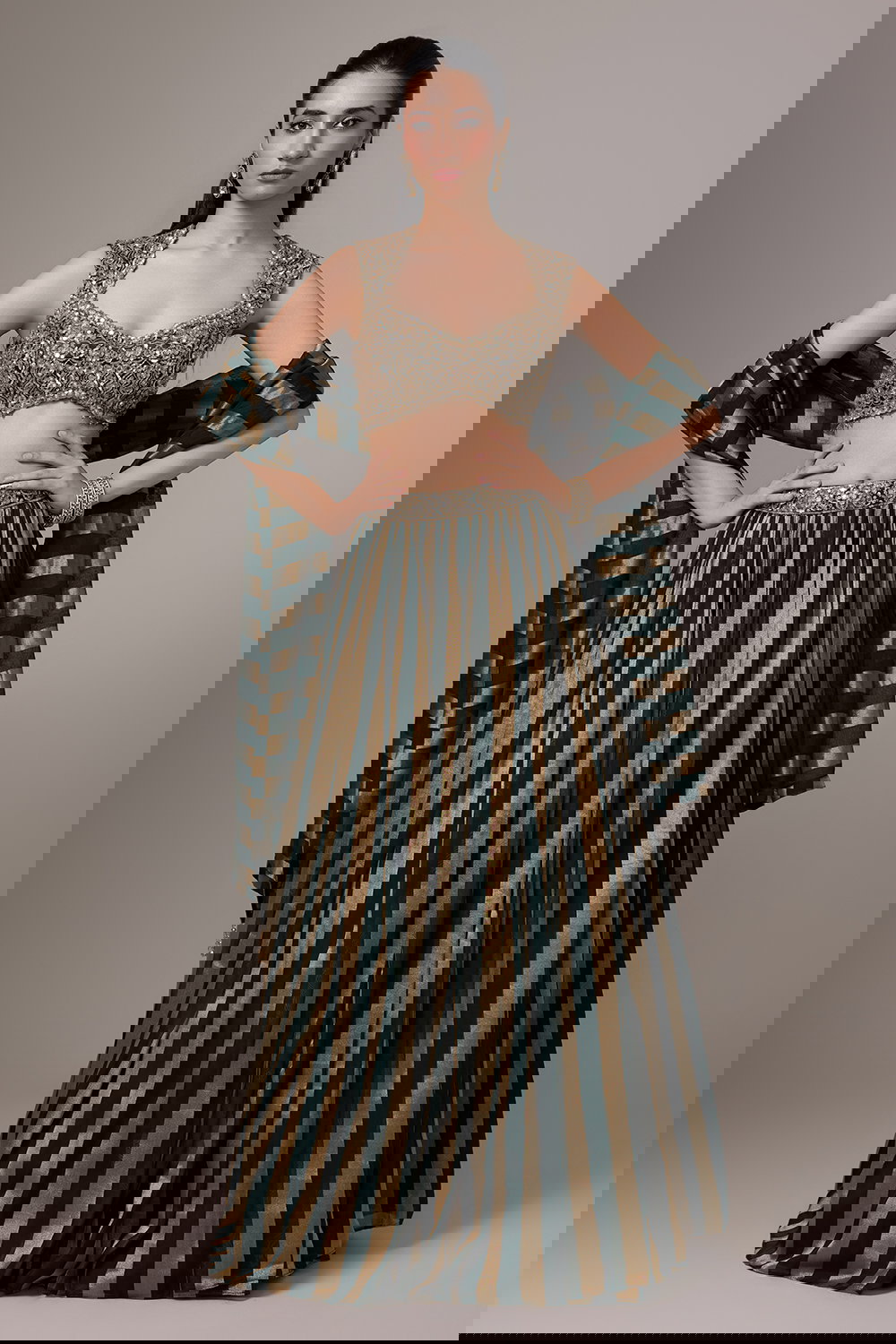
Vertical
lines can stop eye movement implying mass and give volume
to a structure. They also equate to power and strength. Horizontal
lines symbolize rest and relaxation. Diagonal lines are dynamic
and action-oriented, they portray dimensions and directions.
Shapes
A
shape is defined as an area that stands out from the space
next to or around it due to a defined or implied boundary,
or because of differences of value, colour, or texture. It
is formed when a line encloses an area. These lined enclosures
create an illusionary focus termed as shapes. Shapes can vary
endlessly and can suggest physical form and direct eye movement
based on the directional movement of lines. Shapes define
figure, create ground relationships and relate forms and figures.
Texture
It
is defined as the surface characteristics of a material that
can be experienced through the sense of touch or the illusion
of touch. In visual images, actual textures can be used, such
as cloth, boxes, small objects, and natural items.
Value
Value
is the relative degree of lightness and darkness in a design
element. Line, colour, texture, and shape all need value contrast
in order to be seen. Value is used to describe objects, shapes,
and space.
Colour
Colour
is the most important part of designing. The primary colours
are red, yellow and blue. They are called primary because
they are not mixture of other colours. Mixing any two primary
colours results in a secondary colour. The colour wheel is
created when the primary and secondary colours are placed
in a circle. Colours directly across from each other on the
colour wheel are called complementary colours. Complementary
colours used together provide extreme contrast.
|
|